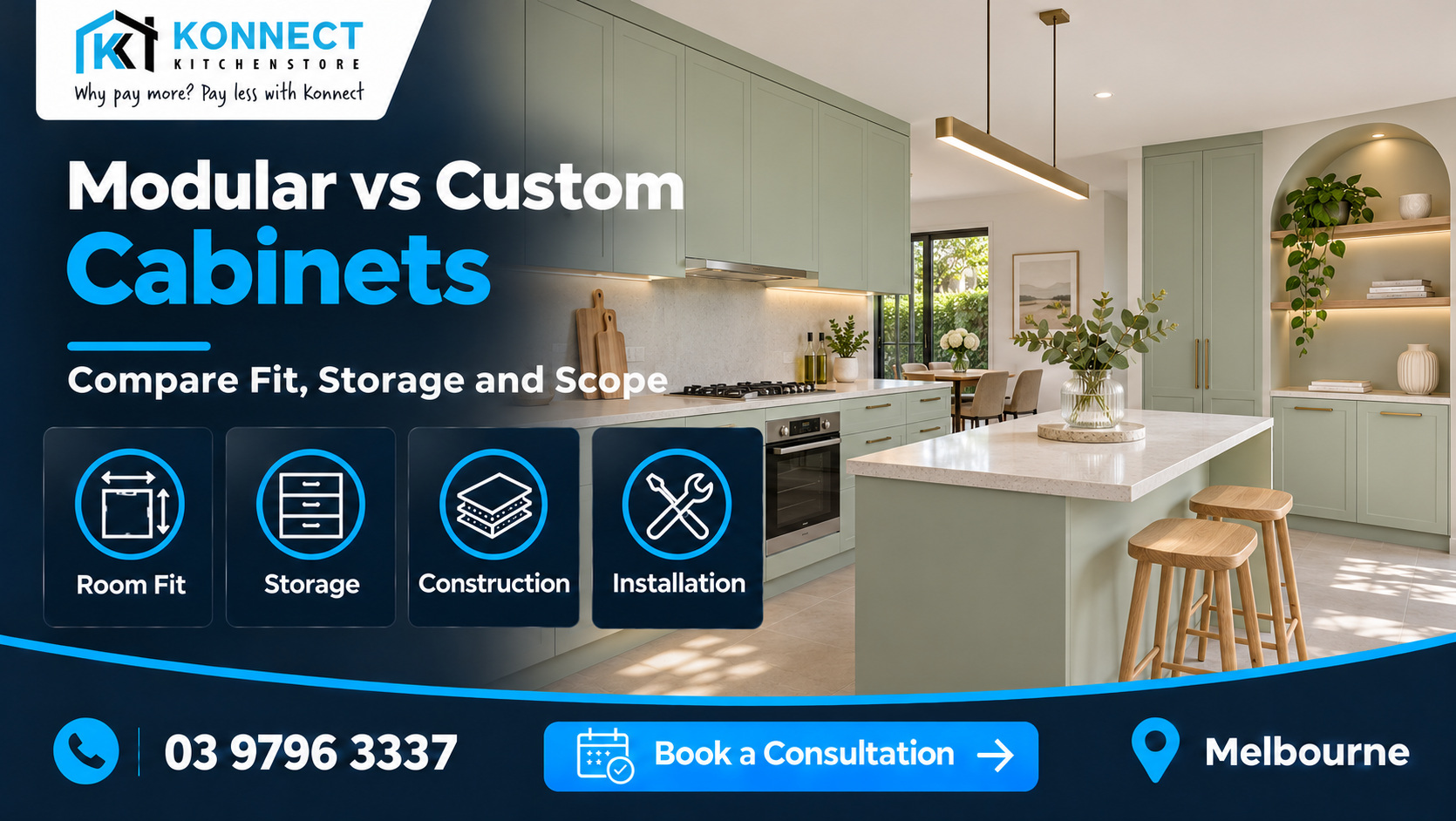
Modular kitchen cabinets use a manufacturer's range of standard units. Custom cabinets are made to an agreed specification for a particular project. When choosing cabinets for a full kitchen renovation, compare how each option fits the room, accommodates your belongings and is supplied and installed.
The labels do not establish quality by themselves. Both approaches need suitable construction, hardware and installation. The useful decision is whether standard units meet the brief or whether particular dimensions and details justify a custom solution.
What does modular cabinetry mean?
A modular kitchen combines individual cabinets from an available range of sizes and configurations. The supplier may offer base units, wall units, tall cupboards, drawers and compatible panels.
The range determines the choices. One system may have several internal fittings and finishes, while another is more limited. Units may be supplied flat-packed or assembled, so confirm the actual product and ordering process.
Modular does not mean freestanding. Modular units can be fitted as part of a built-in kitchen. The term describes the system of units, rather than whether the finished cabinetry is fixed in place.
What does custom cabinetry mean?
Custom cabinetry is made around agreed project dimensions and selections. It can help address an awkward wall, a particular appliance or storage requirements that do not fit a standard range.
That flexibility still has boundaries. Material sizes, hardware, appliance requirements, fabrication methods and the room itself affect what can be built.
A clear specification matters more than a promise of unlimited choice. Confirm the dimensions, finishes, internal arrangement and installation scope before manufacture. A custom order is most useful when it solves an identified requirement.
Compare the fit in your actual room
Place the same appliance list and storage brief into both options. Mark openings, corners and the points where cabinets meet walls or adjacent furniture.
Standard units may fit comfortably, with suitable fillers or finishing panels. In another room, custom dimensions may make an awkward section more useful.
Check the finished appearance as well as the cabinet boxes:
- How will the end of each run be finished?
- Where are fillers required?
- Can adjacent drawers and doors open properly?
- Does the arrangement leave useful preparation space?
- Are service and appliance requirements included in the plan?
A tailored cabinet width can help, but it is not a substitute for resolving the overall kitchen arrangement.
Look inside the storage
Compare what the cabinets will hold, rather than only the number of doors. A standard drawer unit may suit your cookware very well; another household may need a particular shelf height or compartment.
Custom storage can accommodate specific contents where the selected hardware and cabinet construction allow it. Modular systems may also offer useful organisers.
Avoid adding special fittings simply because they are available. Inventory the items you use, decide where they belong and compare the internal capacity of each option. The cabinet should serve the contents comfortably.
Compare construction and finishes separately
Modular and custom describe how the cabinetry is specified and produced. They do not tell you the exact board, finish, edging, hinges or drawer runners.
Request those details for both quotes. Compare the cabinet material specifications independently of the manufacturing label.
A custom cabinet is not automatically stronger or easier to maintain. Equally, a standard unit should not be dismissed without reviewing its actual construction and suitability. Judge the product you are being offered.
Clarify supply, assembly and installation
Ask who measures the room, assembles the units and installs the kitchen. Check responsibility for panels, handles, adjustments and any work around existing services.
An available standard unit may shorten one part of the process, but the complete schedule also depends on design, other products and installation bookings. Custom production has its own lead time, which needs to be confirmed for the agreed selections.
Compare the same milestones. A delivery date for cabinets is different from a finished kitchen ready for use.
Compare the complete installed scope
Price the same plan and product requirements wherever possible. Include the work and components needed to turn the units into the intended kitchen.
For kitchen projects with a limited budget, modular units may offer a suitable route, while targeted custom work may solve a difficult section. Confirm whether a combined approach is available for the project.
Review the trade-offs before choosing. Paying for customisation has a clear purpose when it provides a fit or function you value, rather than simply a different label.
Frequently Asked Questions
What is a modular kitchen cabinet?
It is an individual unit from a system of standard cabinet sizes and configurations. Those units are combined to form the kitchen. The available finishes, fittings and supply format depend on the manufacturer, so modular cabinets are not all supplied in the same way.
Is a modular cabinet different from a built-in cabinet?
The terms describe different things. Modular refers to a system of units, while built-in describes cabinetry fitted into its setting. A modular unit can form part of a built-in kitchen, and built-in cabinetry may also be custom-made for the room.
Are modular kitchen cabinets always cheaper than custom cabinets?
No. Standard production can offer a cost advantage, but the complete price depends on the range, hardware, finishes and installation required. Compare the same kitchen scope. A basic unit price does not show every component needed for the finished room.
Do custom cabinets always make better use of corners?
They can address particular dimensions, but the result still depends on the design and selected fittings. A custom corner can remain awkward if its contents are hard to access. Compare how you will use the actual cabinet rather than assuming custom sizing resolves every issue.
Can modular cabinets include pull-out storage?
Yes, where compatible fittings are available for the selected system and cabinet size. Check the internal dimensions and intended contents before ordering. Custom cabinetry can also use standard hardware, so pull-out storage is not exclusive to either approach.
Can modular and custom cabinetry be combined?
Sometimes, depending on the supplier, finishes and construction approach. A project may use standard units in straightforward areas and custom components elsewhere. Confirm compatibility, responsibility for measurements and the complete installed appearance before relying on a mixed arrangement.
Compare two specifications against one brief
Bring Konnect Kitchen Store your room dimensions, appliance list and the storage requirements you cannot compromise on. Our Hallam team can discuss where standard sizes may work and where a tailored component could add value. Contact us to compare the cabinetry options for your room, or call 03 9796 3337.