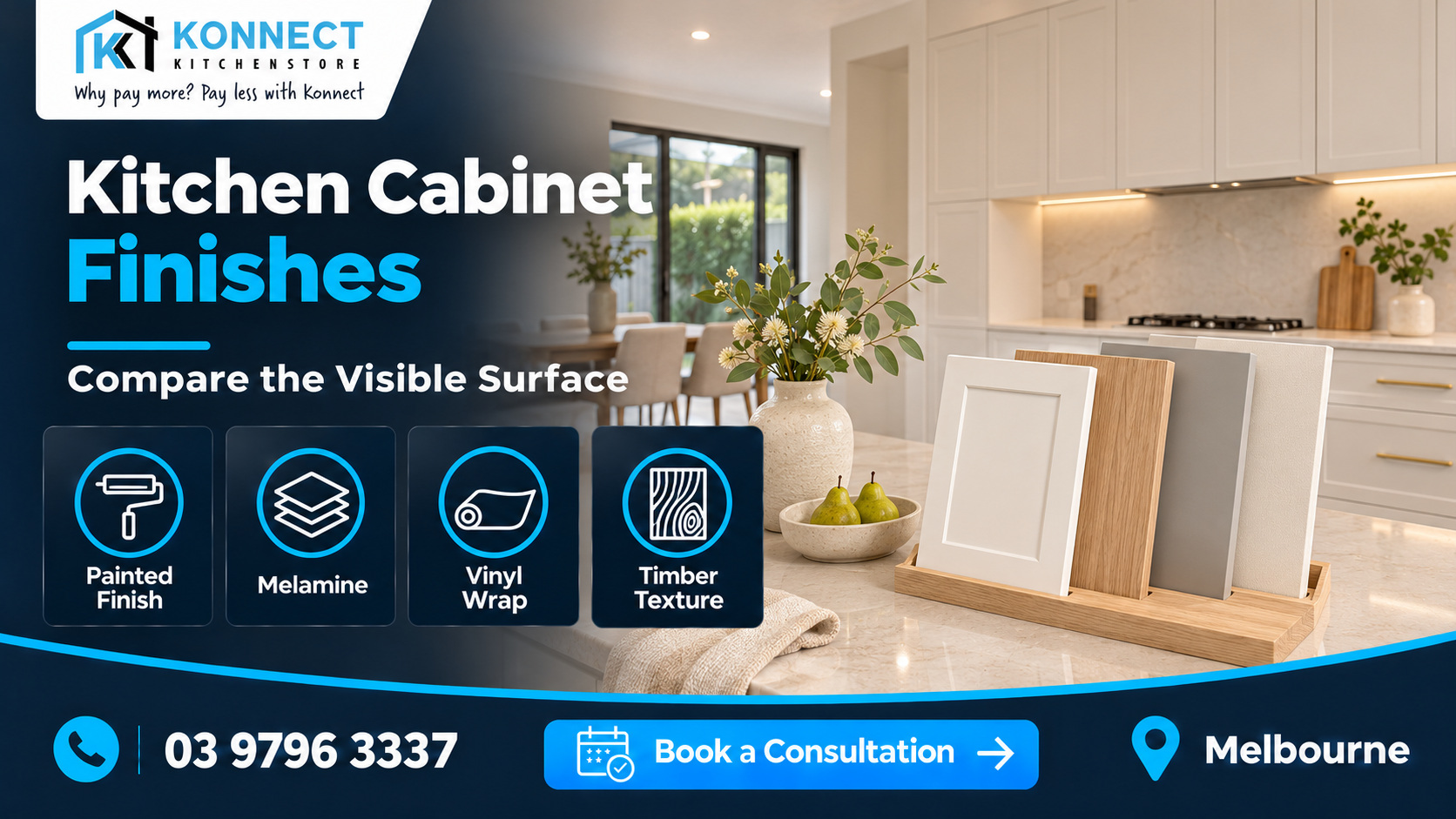
A cabinet finish affects the colour, texture and care of the surfaces you see and touch. When you plan your kitchen renovation, compare that finish with the door profile, underlying material and location of the cabinetry.
Painted surfaces, decorative boards, wrapped doors and timber finishes are different systems. A sample can show the appearance, while the specification and care instructions explain what you are selecting. Neither the price label nor the sheen level tells the whole story.
Start with the appearance and application
Decide whether you prefer a plain colour, timber character or another texture. Then compare the available products for the proposed door profile and use.
Matte, satin and gloss describe different surface appearances, but the terminology and available range vary between suppliers. Look at actual samples under the room's lighting.
Ask about the door edges, reverse face and visible end panels as well. A coordinated kitchen needs those details resolved alongside the main door colour.
Painted and two-pack finishes
A painted cabinet front uses a coating system applied to a suitable surface. Two-pack polyurethane is one option offered for cabinetry, with available colours and sheen levels depending on the supplier's system.
Compare the actual sample, coating specification and preparation process. The final product depends on more than the colour selected.
Discuss repair and touch-up options before ordering. A painted surface is not automatically easy to repair invisibly, and a custom colour does not guarantee that every later replacement will match perfectly.
Follow the care instructions for the finished coating rather than using a general cleaning recipe.
Melamine-faced decorative boards
Melamine-faced boards combine a decorative surface with a specified substrate. They are available in different colours, patterns and surface textures.
Low-pressure melamine and high-pressure laminate are related decorative products with different constructions and applications. Ask which product is being quoted rather than treating every laminate-related term as identical.
Check the edges and how the selected board can be used for the intended doors and panels. A sample's face does not show the complete construction.
The cabinet material breakdown explains the separate role of the core beneath that decorative surface.
Vinyl-wrapped and thermolaminated doors
Wrapped or thermolaminated doors use a formed decorative surface over a suitable core. Particular systems can cover the face and profiled edges, making different door shapes available.
Ask for the precise product and its installation requirements. A wrapped finish is not limited to a glossy appearance, and products differ in their available colours and textures.
Heat, steam and moisture requirements need attention around relevant appliances. Manufacturer guidance should inform the design and any required protective details. Avoid assuming a continuous-looking face has no limitations or care needs.
Timber veneer and solid-timber surfaces
Timber veneer places a thin layer of real wood over another substrate. Solid-timber components use wood itself, with the selected coating contributing to the finished surface.
Compare grain direction, colour variation and how adjoining pieces will be arranged. Natural variation can be part of the intended appearance, so discuss what to expect across the whole cabinet run.
The protective finish affects care. Ask for the instructions that apply to the exact coating and product. A household mixture suitable for one material should not be assumed appropriate for every timber or veneer surface.
Compare sheen and texture in the room
A reflective surface can respond differently to windows and artificial lighting from a matte or textured one. Review samples vertically, as the doors will be installed.
Consider both appearance and touch:
- Where will hands contact the surface?
- How visible are marks on the actual sample?
- Does the texture suit your cleaning routine?
- How do the door and benchtop look together?
- Are matching or coordinating panels available?
Claims such as fingerprint-resistant relate to particular products. They should not be extended to every surface with a similar sheen.
Request a care and selection record
Keep the finish name, colour, sheen, manufacturer and relevant product information with the approved drawings.
Ask which cleaning methods are recommended and which should be avoided. Manufacturer technical and care resources show why instructions need to match the product rather than the broad category alone.
Confirm heat and moisture requirements, repair options and any installation qualifications before final approval. These are part of selecting a finish you will be comfortable using.
Choose the complete surface system
Place the preferred finish beside the work surface, splashback and flooring samples. Then confirm that the door profile, core, edging and hardware support the same design.
The useful result is a documented product choice, not simply a request for matte white or timber cabinets. Clear selections help both the appearance and the practical expectations of the finished kitchen.
Frequently Asked Questions
Is two-pack a cabinet material or a finish?
It generally refers to a two-component coating system used to finish a suitable cabinet surface. It does not identify the whole cabinet construction. Ask for the door core, coating specification and sheen separately so you understand the complete product.
Are vinyl-wrapped cabinet doors always glossy?
No. The available colours and surface appearances depend on the manufacturer's range. Compare the specific product and profile. The term wrapped describes the finish system rather than requiring a particular sheen or style.
Are melamine and high-pressure laminate identical?
No. They are distinct decorative products, even though related terminology is sometimes used broadly. Their construction and intended applications differ. Ask for the exact product, substrate and edging rather than assuming the names describe the same surface system.
Can I use the same cleaner on every kitchen cabinet finish?
No. Follow the care instructions for the actual product and coating. Painted, wrapped, decorative-board and timber surfaces can have different requirements. Avoid transferring a cleaning recipe from an unrelated material simply because the cabinets look similar.
Which cabinet finish hides fingerprints best?
That depends on the exact product, colour, texture, lighting and how it is touched. Some manufacturers offer particular fingerprint-resistant surfaces. Compare real samples and the stated product characteristics rather than assuming every matte or textured finish performs the same way.
Can a damaged cabinet finish always be repaired without replacing the door?
No. Repair options depend on the surface system, damage and availability of a suitable match. Ask about the options for your selected product before ordering. A repaintable or replaceable component does not guarantee an invisible local repair.
Compare finishes you are willing to care for
Bring Konnect Kitchen Store the colours and surface textures you like, along with any maintenance concerns. Our Hallam team can discuss how the available specifications fit your cabinetry plan. Contact us to compare finish samples and care requirements, or call 03 9796 3337.