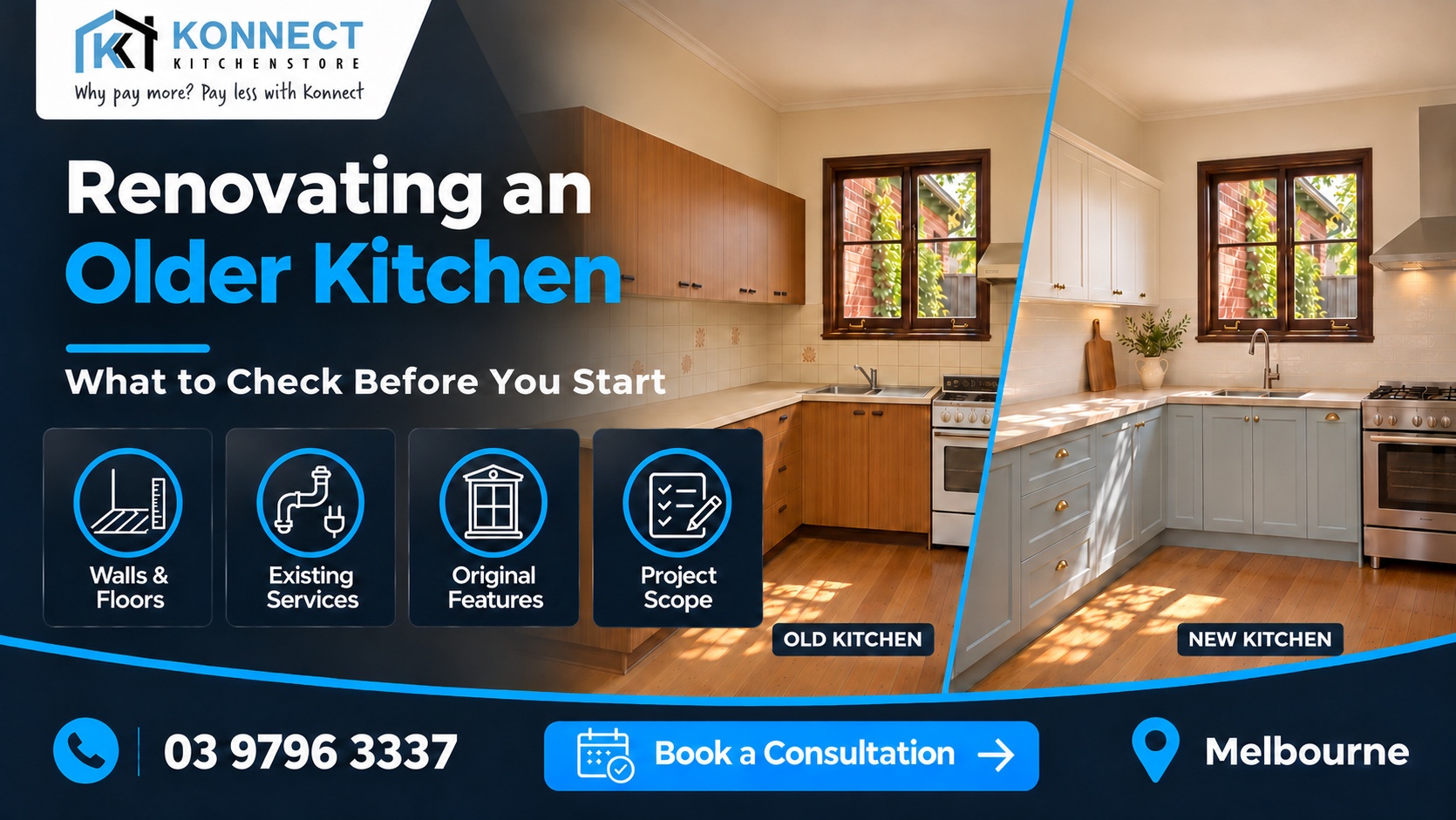

Refacing updates suitable existing cabinetry, while replacement removes and changes the cabinet structures themselves. Whether you reface or choose a full kitchen renovation, the useful decision begins with the condition and arrangement of what is already installed.
A cosmetic update can suit sound cabinets that work well. Replacement deserves consideration when damage, poor fit or an unsuitable layout prevents the result you need. Compare the complete scope rather than assuming either approach is always cheaper or faster.
Clarify what refacing includes
Providers use refacing, resurfacing and refinishing differently. One proposal may replace doors and drawer fronts; another may apply a new surface to suitable visible components.
Painting an existing door is also different from supplying a new one. Internal fittings, handles, end panels and drawer boxes may be included or excluded.
Ask for a written description of what stays and what changes. The word refacing alone does not show how much of the existing kitchen will remain.
Check the cabinet structures first
Inspect the condition of the boxes, shelves, fixing points and areas near the sink or appliances. Look for swelling, movement or damage that needs assessment.
New fronts do not restore a deteriorated cabinet core. A moisture problem also needs its source addressed before a decorative finish is considered.
Some cabinet maintenance problems may be local, while others affect the suitability of retaining the kitchen. Have the condition assessed before ordering components around it.
Decide whether the arrangement still works
Refacing generally keeps much of the existing cabinet arrangement. That can be an advantage when the storage, preparation space and appliance positions already meet your needs.
If the central problem is a lack of useful drawers, an awkward corner or a poor working surface, identify whether the proposed update actually solves it.
Replacement can create more opportunity to change the arrangement, but the room, services and budget still set boundaries. It does not make every imagined layout possible.
Consider everything connected to the cabinets
Benchtops, sinks, splashbacks, appliances and flooring may be affected by either option. Confirm what is being retained and how the new components meet it.
A benchtop installed on cabinets that later need replacement may create repeat work. Conversely, retaining sound cabinetry and compatible surfaces may suit a limited update.
Ask about removal, support and access before deciding the work is purely cosmetic. Existing stone or other fitted surfaces should be assessed by suitable installers rather than cut or altered casually.
Compare complete quotations
Price the work needed for the intended result:
- Doors, drawer fronts and visible panels.
- Hardware and internal changes.
- Preparation or removal work.
- Required installation and adjustments.
- Related appliance or service work.
- Disposal and any separately supplied items.
Refacing may retain more material, but there is no universal saving percentage. Extensive repairs or difficult matching can change the comparison.
For budget-conscious kitchen work, ask whether a smaller, clearly defined update addresses the main problem before committing to a broader specification.
Compare disruption using the actual schedule
Retaining cabinet structures can reduce some tasks, but lead times still depend on the selected products, preparation and installer availability.
Replacement may involve more connected work, particularly if services or the layout change. Ask for the expected sequence and the period when facilities will be unavailable.
Avoid comparing a door-delivery estimate with a full installation schedule. Both proposals need the same start and finish milestones to be meaningfully assessed.
Choose based on the outcome
Refacing is worth assessing when the cabinet structures are sound, the arrangement works and the proposed finish is compatible.
Replacement is worth assessing when the structures are unsuitable or the planned improvements require a different configuration.
A mixed solution may sometimes be possible, but check matching, interfaces and responsibility for the whole installation. The result should address the kitchen's actual problems rather than merely changing what is visible.
Frequently Asked Questions
What does kitchen cabinet refacing mean?
It generally updates visible cabinet components while retaining suitable structures. The exact work varies, so confirm whether the proposal includes new fronts, surface treatment, end panels, hardware or internal changes. The label alone is not a complete scope.
When is cabinet replacement more appropriate?
Replacement deserves assessment when structures are damaged or unsuitable, or when the layout and storage need changes that retention cannot provide. The decision should follow inspection and a clear brief rather than the appearance of the doors alone.
Does refacing always cost half as much as replacement?
No. There is no universal percentage. The condition of retained cabinets, selected fronts, hardware and preparation work affect the price. Compare complete installed options for the outcome you want.
Can I keep my benchtop when replacing cabinets?
Possibly, but removal, support, condition and compatibility need assessment. Do not assume a fitted surface can be lifted and reused without damage or modification. Have the proposed sequence and responsibilities confirmed before relying on retention.
Can refacing improve kitchen storage?
It may include compatible internal changes, but the retained cabinet dimensions limit the options. Confirm what is being altered and how it improves access. New door fronts alone do not create additional usable storage.
Is refacing automatically the better environmental choice?
Retaining suitable components can reduce what is removed, but the full impact depends on materials, work and service life. Ask what will actually be retained and replaced. Avoid treating a broad environmental claim as a substitute for a suitable design.
Make the retention decision with the whole kitchen in view
Bring Konnect Kitchen Store photographs, your main storage or layout concerns and a list of components you hope to keep. Our Hallam team can discuss the renovation options and what needs assessment. Contact us to compare retention and replacement scopes, or call 03 9796 3337.